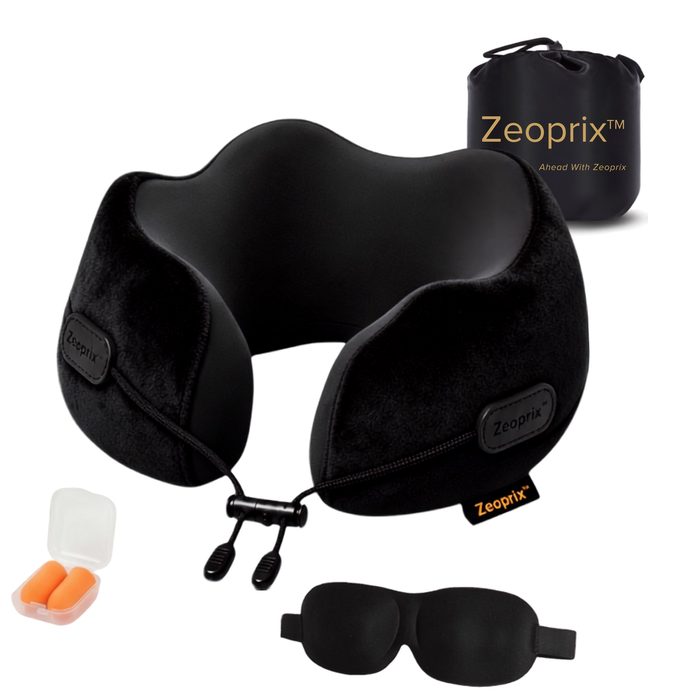
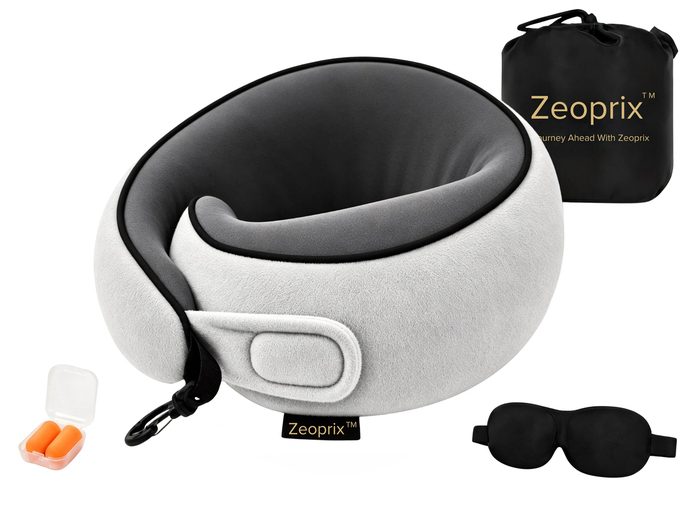
Press a thumb into a slow-rebound memory foam pillow and let go. The dent stays for a moment, then fills back in on its own. Nearly every travel pillow listing mentions the foam. Few explain why that slow return matters once you are in a seat.
It matters because it decides what the pillow does after you settle into it: hold the shape your head pressed into it, or keep pushing back. Here is what slow rebound is, where it came from, what density does and does not tell you, and what no foam can promise.
What is slow-rebound memory foam?
Slow-rebound memory foam is foam that gives way under steady pressure and returns slowly once the pressure is gone, instead of springing straight back.
Its technical name is viscoelastic polyurethane foam, and the Polyurethane Foam Association calls it slow recovery foam. The lab test is a dropped steel ball: other flexible foams typically send it back up 50 to 60 percent of the drop height, viscoelastic foam less than 20 percent. That is why the industry also calls it low-resilience foam. It sounds like a flaw. In a pillow it is the point, because foam that does not bounce does not keep nudging your head.
If you have ever rolled a foam earplug thin and felt it expand slowly in your ear, you have felt the same behavior.
Did memory foam really start on airplanes?
It did: memory foam was developed in 1966 under a NASA contract to make airplane seats safer in a crash and more comfortable on long flights.
The engineer, Charles Yost, created an open-cell foam with unusual viscoelastic properties, and NASA's Ames Research Center built it into a new seat design. NASA's account says it was first called slow spring back foam, because it flowed to match the body pressing against it and returned to its original shape once the pressure was removed. The comfort came from spreading weight and pressure evenly over the whole contact area.
A memory foam travel pillow takes the material back to where it started: a passenger seat.
How does slow rebound feel in a seat?
It feels like the pillow takes your shape and keeps it, instead of pushing your head back out.
When you lean in, the foam under your jaw and along your neck gives way gradually and contours closely to you, which spreads the pressure over a wider area. Shift a little and it follows slowly instead of springing back at you.
You can see it at the top of this page and early in the 360° Wrap video: a finger presses into the foam, lifts away, and the dent stays behind for a moment.
Does higher density make memory foam firmer?
No: density and firmness are separate measurements, and high-density foam can be made soft.
Firmness is the force it takes to press foam down by a quarter of its height, the surface feel you notice when you first lean in. Density is the weight of one cubic foot of the foam. The Polyurethane Foam Association treats the two as independent: high-density foam can be made very soft and low-density foam very firm.
What density changes is support and how long it lasts. Support is the foam's ability to push back against weight without collapsing to the bottom; foam that is too soft for its density and thickness bottoms out, and your shoulder ends up doing the holding. Denser foam also keeps its height and feel longer, because all foam loses a little of both with use.
A quick test: press a thumb in slowly and keep going. Good support gets firmer the deeper you press.
| Term | What it measures | What you notice in a seat |
|---|---|---|
| Firmness | Force to press the foam down a quarter of its height | How soft it feels when you first lean in |
| Density | Weight of one cubic foot of foam | Whether it keeps holding you up, trip after trip |
| Support | How hard the foam pushes back as it compresses | Whether your head sinks through to the seat |
| Resilience | How high a dropped steel ball bounces | Whether the pillow pushes back or gives way |
| Recovery | How fast a dent fills back in | Whether your spot is still there after you move |
Why does a memory foam pillow feel hard when it is cold?
Because memory foam stiffens as it cools and softens as it warms, so the same pillow feels firmer on a cold morning than it does once your body has warmed it.
The Polyurethane Foam Association puts the best range for the memory effect at about 55 to 85°F (13 to 29°C). Below that, recovery slows and some formulations turn stiff, while humid air softens the foam. How much depends on the formulation; NASA notes that later versions of the original foam were made less sensitive to temperature.
The fix is to warm it before you judge the fit. If the pillow spent the night in a cold car, wear it for a while before you tighten or adjust it. It softens and recovers faster as it warms.
What can memory foam not do?
It cannot fix the wrong shape: the foam decides how the support feels, and the pillow's shape decides where the support is.
If your head drops forward when you fall asleep, the best foam in a U-shape still leaves your chin with nowhere to land; U-shaped vs wraparound covers that choice. Foam will not stay new forever either, and density slows the wear without stopping it. The foam core is spot-clean only, so the cover is what goes in the washer. And memory foam is a comfort material, not a treatment: for neck pain, ask a doctor or physical therapist.
Both Zeoprix pillows use slow-rebound memory foam and differ in shape. The Classic is high-density, slow-rebound memory foam in a U-shape, with a cord lock that tightens the front opening. The 360° Wrap is one piece of slow-rebound memory foam, not shredded fill or microbeads, that wraps around your neck and closes under your chin. Both compress into their carry bag, both covers go in the washer and dryer, and both come with an eye mask and earplugs. Compare the two shapes or read the buying guide. Both are sold through our official Amazon listings.
What else do travelers ask about memory foam?
The questions that come up most are about names, packing, and fill.
FAQ
Is slow-rebound foam the same as memory foam?
Yes. Slow rebound, slow recovery, viscoelastic and memory foam all describe the same kind of foam, and temper foam was its original commercial name.
How long does memory foam take to recover after packing?
There is no fixed number, because temperature changes it. Take the pillow out of its bag when you sit down rather than when you want to sleep. It keeps filling out while you wear it, and warmth speeds that up.
Is shredded memory foam the same as a solid piece?
Same kind of foam, different behavior. Shredded fill moves around inside the cover, so you can push it where you want it, and it can also move away from where you put it. A solid piece keeps the shape it was cut to.